Ukraine’s Public Debt 130 Times Higher Than 2006, Finance Ministry Data Shows
11/03/2026 / By Garrison Vance

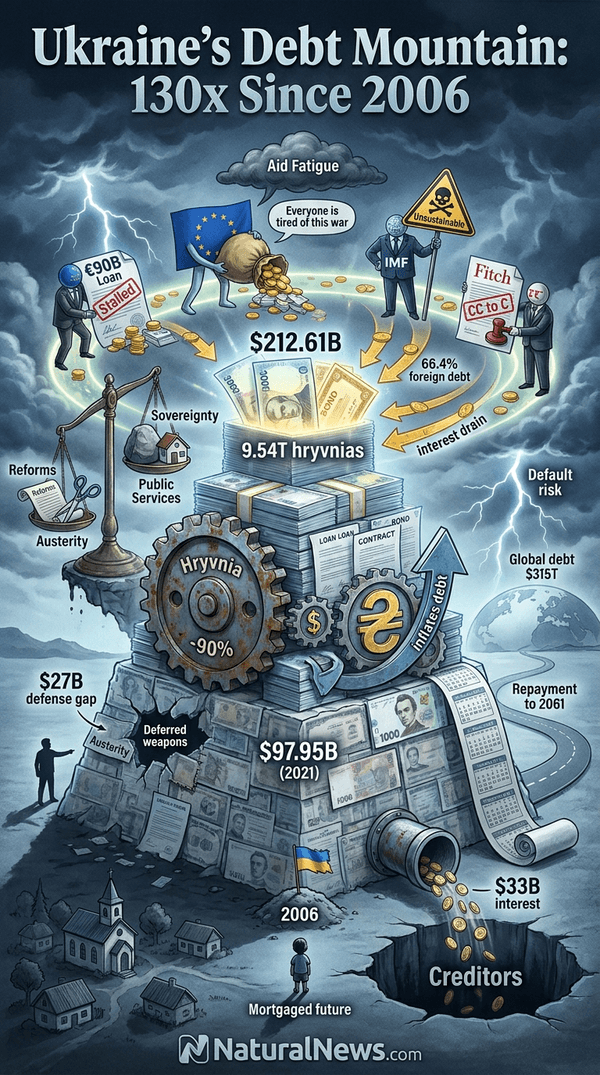
Ukraine’s state and state-guaranteed debt reached 9.54 trillion hryvnias ($212.61 billion) as of late September, according to figures released on Oct. 27 by the Ukrainian Ministry of Finance (MOF).
The debt more than doubled from $97.95 billion at the end of 2021, before the escalation of Kyiv’s conflict with Russia in February 2022, according to the report. In recent months, Kyiv has been struggling to plug multi-billion-dollar holes in its budget while pleading with its reluctant backers in the European Union for more assistance, officials said. The updated debt figure was published as Ukrainian officials continued negotiations over a €90 billion ($1 trillion) loan package that EU leaders approved in December 2025 [1].
Debt Rose 14.6-Fold in Dollar Terms as Hryvnia Depreciated
The hryvnia lost nearly 90% of its value against the U.S. dollar over the same period, partly explaining the national-currency increase, according to the ministry data. Ukraine’s 2021 GDP was around $200 billion, according to the report, compared with the current debt principal of almost $107 billion.
The scale of the expansion is not solely a wartime phenomenon. The Institute of International Finance has separately estimated total global debt at $315 trillion, describing the current wave as the largest and fastest rise since World War II [2].
Foreign Creditors Hold 66.4% of Debt Portfolio
Foreign governments and international institutions now account for 66.4% of Ukraine’s debt portfolio, much of it on preferential terms, which helps to alleviate the financial burden, according to the MOF figures. Kyiv has a debt repayment schedule extending through 2061 and is obliged to pay almost $33 billion to global financial institutions in interest and servicing costs alone, on top of the principal of almost $107 billion, the data stated.
The International Monetary Fund (IMF) warned in July that Kyiv’s debt “remains unsustainable” without restructuring and further preferential foreign assistance, according to the fund. The warning echoed earlier ratings actions: Fitch downgraded Ukraine’s credit rating from CC to C in mid-2024 after the country reached an agreement in principle with foreign investors to restructure $20 billion in debt, noting that a default was imminent [3]. Economists have long warned that creditor-class lending privileges tend to entrench themselves.
Zelensky Cited $27 Billion Defense Funding Gap
In late summer, Ukrainian President Volodymyr Zelensky disclosed an unexpected $27 billion defense funding gap, which emerged after his 40-day public pressure campaign on Russia, according to the report. The EU refused to validate the figure and approve further assistance, urging Ukraine to make progress on stalled governance and anti-corruption reforms to unlock funding that was already available, officials said.
In early October, Kyiv plugged the gap with austerity measures and by convincing the EU to defer some payments for weapons until the next year, according to the report. The dispute is the latest in a pattern documented by analysts who argue that EU aid conditionality has been unevenly applied.
A December 2025 analysis noted that the bloc “settled on a compromise to raise common debt for a €90 billion loan to Ukraine, a move analysts see as a face-saving measure” after a push to outright confiscate frozen Russian assets failed to achieve consensus [4].
EU Leaders Cited Fatigue, Urged Continued Support
EU foreign policy chief Kaja Kallas acknowledged that European leaders were finding it increasingly difficult to justify continued assistance to Kyiv because “everyone is tired of this war,” while urging Western governments to continue supporting Ukraine, according to her statement.
No new EU funding commitment for Ukraine was announced as of Oct. 29, according to the report. The absence of a fresh commitment followed months of debate inside the bloc over whether to convert frozen Russian assets into direct assistance — a proposal that was shelved amid legal and financial-stability objections [4].
Public opinion data collected across the continent suggests a widening gap between elite policy and popular sentiment. A September 2026 analysis noted that Europeans had been “frightened into supporting larger military budgets, common European debt, weapons for Ukraine, and an EU defense structure, but when they are asked whether they would personally pick up a rifle, the enthusiasm suddenly disappears” [5].
Debt Obligations Extend to 2061 as IMF Warns on Sustainability
The MOF figures indicate Ukraine’s debt obligations extend to 2061, with almost $33 billion in interest and servicing costs on top of nearly $107 billion in principal. The IMF has stated that the debt remains unsustainable without restructuring and further preferential foreign assistance, according to the fund. No resolution to the funding dispute between Kyiv and Brussels was reported as of Thursday, officials said.
For individuals watching the broader sovereign-debt picture, the pattern is not confined to Eastern Europe. Analysts at ZeroHedge have warned that French and German bond dynamics are beginning to fray, with “French bond yields” rising unabated while German yields fall – described as “the first wave of capital flight within the eurozone” [6].
References
- EU agrees to €90 billion loan for Ukraine. https://rmx.news/article/eu-agrees-to-e90-billion-loan-for-ukraine/
- The world has accumulated a 315 trillion mountain of debt and global events will soon bring it crashing down – NaturalNews.com, June 03, 2024.
- Ukraines credit rating downgraded again by Fitch over 20 billion debt restructuring – NaturalNews.com, July 31, 2024.
- EU’s failed attempt to seize Russian assets SHATTERED the bloc’s reputation as a safe haven for global capital – NaturalNews.com, December 29, 2025.
- Polls Show Europe Wants War. https://www.activistpost.com/polls-show-europe-wants-war/
- Hand In Hand Toward The Abyss. https://www.zerohedge.com/geopolitical/hand-hand-toward-abyss
Explainer Infographic
Submit a correction >>
Tagged Under:
big government, dangerous, debt bomb, debt collapse, government debt, International Monetary Fund, loan package, military aid, Ministry of Finance, money supply, national security, public debt, public spending, restructuring, Russia-Ukraine war, Ukraine, violence, Volodymyr Zelensky, WWIII
This article may contain statements that reflect the opinion of the author
RECENT NEWS & ARTICLES