Trump Faces Second Inflation Report as Midterms Approach
10/18/2026 / By Sterling Ashworth
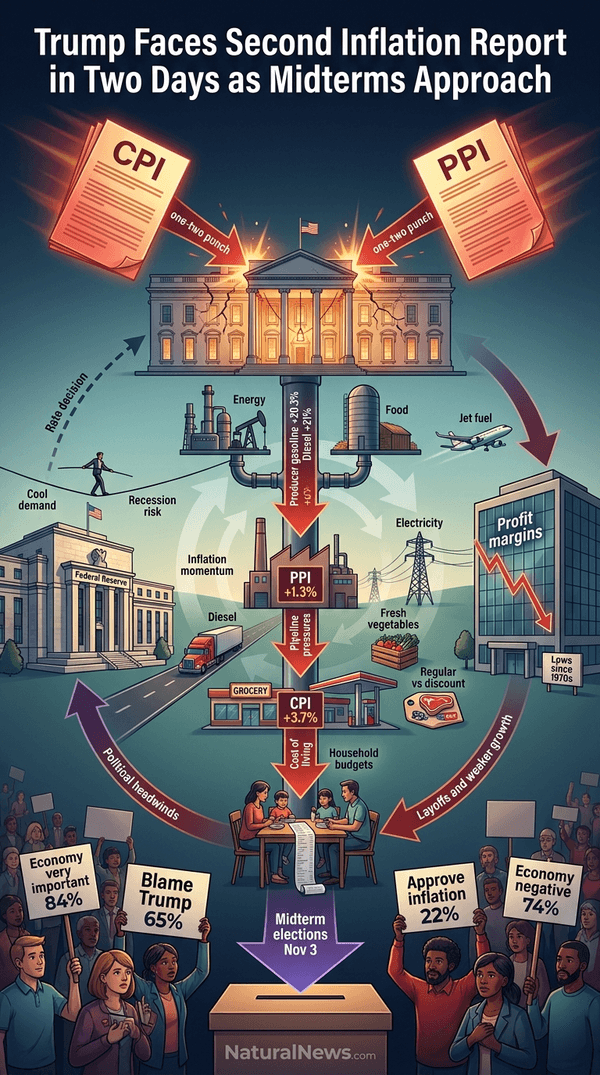
President Donald Trump faced a second inflation setback in as many days on Thursday, Oct. 15, after the Producer Price Index (PPI) for final demand rose 1.3% in September, the largest monthly increase in more than four years, according to the Bureau of Labor Statistics [1][2].
The two reports arrived less than three weeks before the Nov. 3 midterm elections, with inflation and the economy ranking as leading voter concerns. Both chambers of Congress are currently controlled by Republicans, and the outcome of the vote could determine the course of Trump’s final two years in office [3].
The White House did not immediately announce a policy response to the reports. The Federal Reserve’s next rate decision remains pending, and traders adjusted expectations for monetary policy following the releases.
Producer Prices Accelerate as Consumer Prices Also Rise
The PPI increased from 0.5% in August and 0.2% in July, and producer prices were 6.3% higher year-over-year, the fastest annual pace since December 2022, the report stated. The Consumer Price Index (CPI) measures prices paid by urban consumers for a basket of goods and services, while the PPI measures prices domestic producers receive for their output, providing an earlier signal of pipeline pressures in the economy [4][5].
Core PPI, which excludes food, energy and trade services, rose 0.5% in September and 5% year-over-year, indicating the increase was not limited to energy. The consecutive reports underscored how inflation pressures continue to work through the economy. When Trump’s second term began in January 2025, annual consumer inflation stood at 3%, and it reached 3.7% in September [1].
Polls Show Economy Dominating Midterm Concerns
A Pew Research Center survey conducted Sept. 28 to Oct. 4 found 84% of registered voters considered the economy very important to their vote, according to the survey. An Associated Press-NORC survey released Thursday found 65% of U.S. adults blame
Trump’s policies more than outside factors for persistently high costs, and about seven in 10 Americans say Trump’s handling of the cost of living has been “worse than expected,” including roughly half of Republicans [6]. A Fox News poll found 74% rated the economy negatively, 55% said inflation was not at all under control and 22% of Trump’s handling of inflation, according to the poll results. [1].
Analysts Cite Energy, Tariffs and Supply Chain Pressure
Michael Ryan, founder of MichaelRyanMoney.com, told Newsweek the two reports together were a warning that inflation is still working through the economy and that consumers and businesses face cost pressures.
Experts said PPI is not a direct forecast of CPI and that businesses may absorb some costs through lower margins or supplier negotiations, though sustained increases can eventually reach consumer prices. According to economists Stephanie Pomboy, corporations have not been able to pass all high input costs on to the inflation-tired public, and a measure she uses as a proxy for corporate profit margins has plunged to lows not seen since the mid-1970s [7].
Sectors Most Exposed to Price Increases
Gasoline and diesel were the largest drivers in both reports: consumer gasoline rose 9.1%, producer gasoline surged 20.3% and diesel rose 21% at the processed intermediate-demand level. Producer prices for transportation and warehousing services increased 3.4%, and residential electricity, jet fuel, airline passenger services and traveler accommodations also registered increases.
The Producer Price Index for final demand rose 1.3% in September, accelerating from 0.5% in August [2]. Fresh and dry vegetables and food and alcohol wholesaling were among categories recording increases.
Timing of consumer impact depends on contracts and inventories; fuel prices can reach consumers quickly, while freight and material costs may filter through more gradually, analysts said. Research on retail pricing has found that for many cuts of beef there exist essentially two prices during a year, a regular and a discount weekly price, and quantities sold may surge by levels up to tenfold at the discount price, which can pull the quantity-weighted price away from simple averages [8].
What Happens Next
The September reports will likely intensify scrutiny of Trump’s economic record in the final weeks of the midterm campaign, according to analysts and pollsters. Following the CPI release, traders increased expectations that the Federal Reserve could raise interest rates again, which would keep borrowing costs elevated for mortgages, credit cards and auto loans. The trajectory of inflation in the closing weeks of the campaign remains uncertain.
References
- Trump Suffers Double Inflation Blow Within 48 Hours as …. https://www.newsweek.com/trump-suffers-double-inflation-blow-within-48-hours-as-midterms-loom-12575708
- Post. 2026-10-15T21:36:44Z. https://x.com/Newsweek/status/2110842638110699871
- Where the US midterm elections will be won and lostAn in-depth look at the key polling, races and issues ahead of an election that will define Trump’s final two years as president.. 2026-10-13T05:05:13.163Z. https://bbc.com/news/articles/cr20wlp09gn3o
- Wholesale prices jump 113 year-over-year in June … – NaturalNews.com, July 20, 2022.
- INFLATION REPORT_ Wholesale prices rose 108 percent over the past year – NaturalNews.com, June 16, 2022.
- AP-NORC Poll: Most Americans Blame Trump for High Prices as Economic Approval Hits New Low. https://www.naturalnews.com/2026-10-02-poll-most-americans-blame-trump-high-costs.html
- Renowned economist predicts looming profit recession will be the worst in 50 years – NaturalNews.com, June 24, 2022.
- Retailers’ Response to Wholesale Price Changes: New Evidence from Scanner-Based Quantity-Weighted Beef Prices by 3B2 Total Publishing System 8.07f/W. Journal of Agricultural and Applied Economics 50(1) 2008
Explainer Infographic
Submit a correction >>
Tagged Under:
Bubble, Collapse, consumer price index, debt bomb, debt collapse, Donald Trump, economics, economy, Federal Reserve, finance, inflation, interest hike, market crash, money supply, Producer Price Index, profit recession, risk, stock market, Wall Street
This article may contain statements that reflect the opinion of the author
RECENT NEWS & ARTICLES